



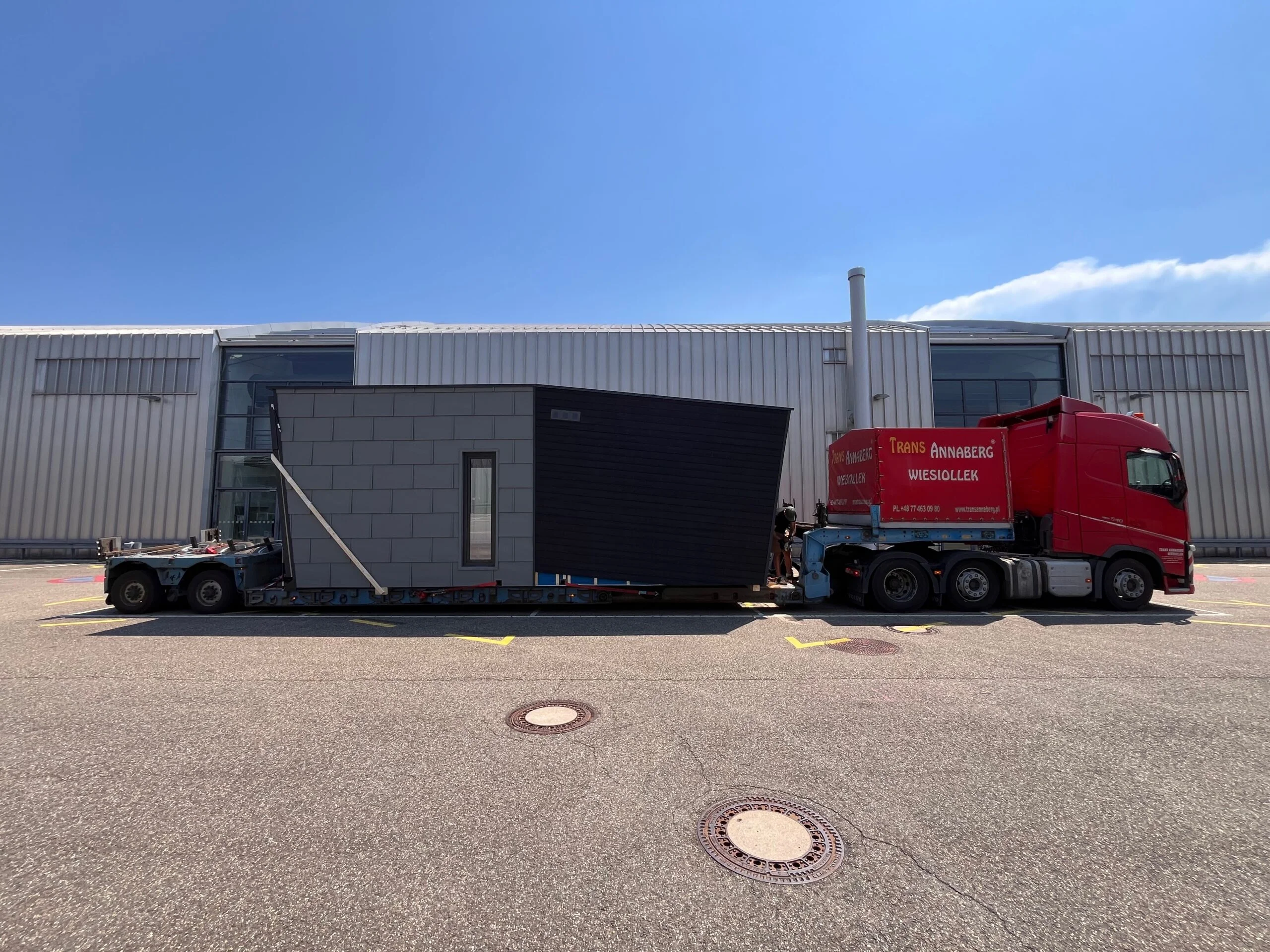
In Poland, transporting a tiny house, meaning a mobile house mounted on a trailer that has not received type approval, is prohibited. Such trailers do not meet the required technical standards and therefore cannot be registered. As a result, transporting a tiny house of this kind is treated as the carriage of an abnormal load.
The transport of oversized loads requires compliance with strict regulations and the acquisition of special permits. A tiny house without type approval may only be transported on a heavy-duty flatbed or low-loader, which requires:
• additional load-securing measures,
• an escort vehicle or transport pilot.
This means that towing such a tiny house independently on public roads is not permitted.
For oversized transport, it is essential to adapt every stage of the operation to the applicable standards and regulations. This helps ensure road safety and the comfort of all road users.
A trailer that has obtained type approval must comply with specific technical standards confirmed by the Polish Transport Technical Supervision authority (Transportowy Dozór Techniczny, TDT). Several important requirements should be kept in mind:
• an overrun brake – mandatory for trailers with a permissible gross vehicle weight exceeding 750 kg,
• vehicle dimensions – the trailer should be no wider than 2.55 m and no higher than 4 m,
• appropriate lighting and markings – the trailer must meet visibility requirements, especially at night,
• trailer design and construction – these must comply with the applicable technical standards,
• an energy performance certificate – required in certain cases,
• all required components and documentation – necessary to obtain type approval and legally use public roads.
Without the relevant certificate, the trailer cannot be registered or legally used.
When purchasing a tiny house from a manufacturer, you can usually choose to have the house built on a type-approved trailer. Such a trailer is already registered and has a registration plate, allowing the house to be transported on public roads. However, remember that the combined weight of the house and trailer must not exceed 3,500 kg. With the appropriate driving licence (category B+E) and a suitable towing vehicle, you may tow the house yourself. Nevertheless, driving with such a trailer is demanding and requires considerable experience.
Registering a type-approved trailer is essential for legally using public roads. To complete the process, you will need several documents:
• the certificate of conformity or type-approval certificate confirming that the trailer meets all required technical standards,
• proof of ownership,
• the vehicle registration document, where applicable.
To register the trailer, visit your local vehicle registration office and submit the appropriate application. It is also important to remember that a separate third-party liability insurance policy is mandatory for trailers with a permissible gross vehicle weight exceeding 750 kg. The cost of such insurance may vary depending on the value and intended use of the trailer.
After the registration procedure has been completed, you will receive the required documents and registration plates. Failing to register or insure the trailer may result in a fine during a roadside inspection, as well as unnecessary expense and delay. Third-party liability insurance protects the owner against civil liability for damage that may occur while the trailer is being used.
For this reason, all documentation should be complete and the applicable regulations should be followed so that the trailer can be used legally and safely.
To drive a vehicle towing a mobile house on a trailer where the combined permissible gross vehicle weight exceeds 3.5 tonnes, a category B+E driving licence is required. A category B licence allows the holder to drive a passenger car with a light trailer of up to 750 kg and to drive a vehicle combination with a total permissible gross vehicle weight of up to 3.5 tonnes. Holders of a B96 entitlement may tow a combination with a total permissible gross vehicle weight of up to 4,250 kg without obtaining a full B+E licence.
A variety of vehicles may be used for towing, including:
• passenger cars,
• pick-up trucks,
• SUVs,
• agricultural tractors.
The towing vehicle should be selected according to the weight of the trailer and the specific transport requirements. Before setting out with a heavier trailer or mobile house, make sure that you hold the correct driving entitlement and that all technical requirements are met. This is essential for road safety. For example, towing a heavier trailer with a permissible gross vehicle weight above 750 kg may require a B+E licence or B96 entitlement, depending on the total permissible weight of the vehicle combination.
To organise the oversized transport of a mobile house effectively, several important aspects must be considered. The trailer should be selected on the basis of its type approval, which confirms that it meets the technical standards established by TDT. The dimensional requirements include:
• a maximum trailer width of 2.55 m,
• a maximum trailer height of 4 m.
The weight of the load is equally important. Mobile houses vary in weight, so suitable securing systems must be used during transport. In some cases, a crane may be required for loading and unloading in order to prevent damage and ensure safety.
Planning the transport route is another crucial stage. Potential road restrictions should be reviewed in advance, including:
• bridges,
• tunnels.
The load must also be correctly marked. These factors have a direct impact on transport safety. When large structures are being moved, it is advisable to use an experienced specialist transport company. An escort or pilot vehicle is often required to ensure that the journey is both lawful and safe.
Correct load distribution and the appropriate choice of transport vehicle are essential for a safe and smooth journey. Careful planning of every stage helps minimise the risk of problems when transporting a mobile house.
Transporting an abnormal load requires the appropriate permits because this type of operation is subject to strict regulations. In Poland, the principal authority responsible for issuing such permits is the General Directorate for National Roads and Motorways (Generalna Dyrekcja Dróg Krajowych i Autostrad, GDDKiA). The permit procedure involves several key steps:
• transport notification – the required forms must be completed and detailed information about the planned transport must be provided, including the dimensions and weight of the load;
• obtaining a transport permit – additional documents may be required depending on the characteristics of the load, and permits are often issued for a specified period;
• transport escort – an escort vehicle or pilot is often required to ensure safety, particularly in difficult road conditions;
• marking and securing the load – the load must be properly marked with suitable boards and weather-resistant signs, and it must be firmly secured to prevent movement during transport;
• compliance with road traffic regulations – those responsible for abnormal load transport must be familiar with the relevant rules, including speed limits and restrictions on travel at particular times.
Failure to comply with these procedures may result in a fine and the transport being stopped, leading to additional costs and delays.
When travelling with a tiny house on a trailer, both safety and comfort are essential. First of all, road traffic regulations must be observed, including requirements relating to:
• speed limits, which may vary depending on the type of road and the weight of the trailer,
• an effective overrun brake,
• appropriate lighting and markings to improve visibility on the road.
Load stability is another key factor affecting travel comfort. The tiny house should be firmly secured so that it cannot shift while the vehicle is moving. The trailer should also be correctly set up, and the route should be planned carefully to avoid obstacles. Weather conditions must also be considered because they can affect towing stability.
Investing in equipment that improves the functionality of the mobile house can also be highly beneficial. Examples include:
• solar panels,
• heating systems,
• other forms of heating,
• regular technical inspections,
• third-party liability insurance.
Following these principles has a positive impact on the overall experience of travelling with a tiny house.